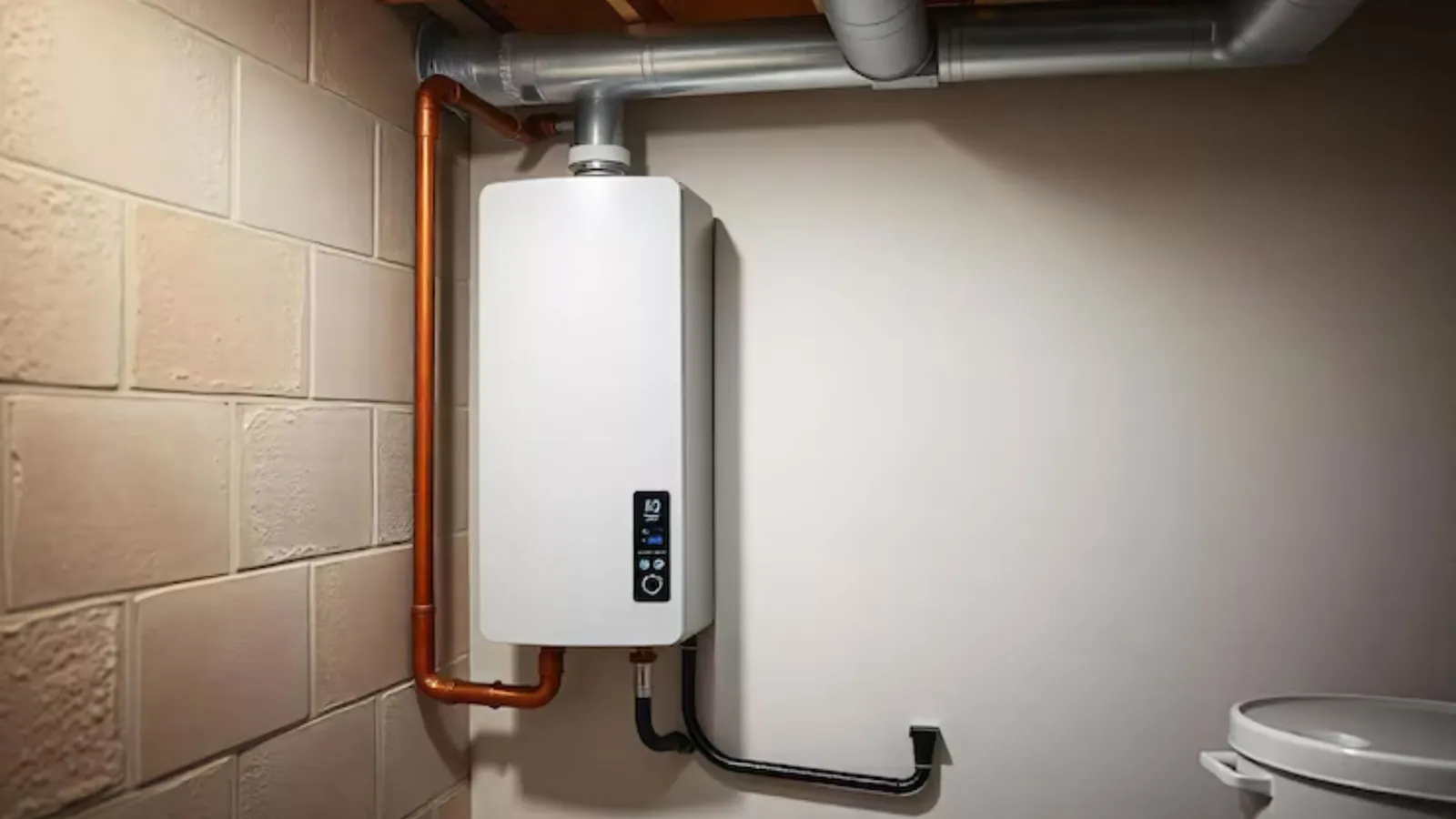
A family of four usually needs a tankless water heater rated for about 8 to 10 gallons per minute, with a gas input around 180,000 to 199,000 BTU for a gas unit. The exact number depends on how many fixtures run at the same time and how cold your incoming water is. Sizing is a calculation, not a guess, and an undersized unit is the most common complaint.
This guide walks through the math, the gas line check and the questions to ask. For installation and repair, see our tankless water heater page.
Step one: add up the flow you need
List the fixtures that could run together at a busy time, such as a morning when two showers run and the dishwasher is on. Add up each fixture's flow in gallons per minute. A shower with a standard head uses about 2.0 to 2.5 gallons per minute. A bathroom faucet uses around 1.0 and a kitchen faucet around 1.5. A dishwasher uses about 1.5 and a washing machine about 2.0.
Two showers, a kitchen faucet and a dishwasher together come to about 8 gallons per minute. That number is your peak demand, and it sets the size you need.
A sample flow worksheet
Use your own household as a starting point.
| Fixture | Typical flow, gpm | Running at once? |
|---|---|---|
| Shower one | 2.0 to 2.5 | Yes. |
| Shower two | 2.0 to 2.5 | Yes. |
| Kitchen faucet | 1.5 | Sometimes. |
| Dishwasher | 1.5 | Sometimes. |
| Washing machine | 2.0 | Rarely at the same time. |
Why oversizing and undersizing both cost you
An undersized tankless unit cannot keep up. Water runs lukewarm when two showers and a dishwasher are on at once, and the unit may shut down on a safety limit. An oversized unit costs more up front and may cycle on and off at low flow, which wastes energy and wears parts. The goal is a unit that covers your real peak, with a modest margin.
Low-flow fixtures help. A shower head rated at 1.75 gallons per minute instead of 2.5 trims the peak demand and lets a smaller unit do the job. Ask about the head ratings before you pick a size.
Step two: find the temperature rise
A tankless heater has a maximum flow at a given temperature rise. The rise is the difference between the incoming water temperature and your target, usually about 120 degrees. In Ohio winters, incoming ground water may be in the low 40s, so the rise is near 80 degrees. In summer it is smaller.
Manufacturers publish flow rates at several rises. A unit that delivers 9 gallons per minute at a 50 degree rise may deliver only about 5.5 at an 80 degree rise. Always size for the winter rise, since that is when your system works hardest.
What the numbers look like in a real house
Take a four-person home with two bathrooms. On school mornings, both showers run for ten minutes while the dishwasher finishes its cycle. That is about 6.5 gallons per minute at once. A unit rated for 8 gallons per minute at the winter rise gives a comfortable margin, and one rated for 5 would run cold. Use your own peak, not the average.
Questions to settle before you buy
Sizing is only part of the decision.
- What is the gas line size.A tankless unit often needs a larger gas pipe than a tank does.
- Where will it vent.Venting runs through a wall or roof in the manufacturer's listed material.
- What are the fixtures.Low-flow heads reduce the load.
- Do you want recirculation.A recirculation pump gives faster hot water at the tap.
- What about water quality.A softener or a yearly flush protects the heat exchanger.
What affects the cost of a tankless install for a family of four
The unit is a larger share of the cost than the labor. The rest depends on the house.
- Unit capacityA bigger flow rate costs more.
- Gas line upgradeA longer or larger pipe can add significant cost.
- VentingA run through the roof costs more than a side wall.
- Electrical workA condensing unit needs an outlet nearby.
- Old tank removalHauling away the old unit is usually included.
Ask for the install quote with the gas line work listed on its own line.
Want your real number? Call (326) 465-0294
Recirculation and wait time
A tankless heater makes hot water on demand, but the pipe from the heater to the tap still holds cool water. You wait for the hot water to arrive, as you would with a tank. A recirculation pump or a built-in recirculation feature keeps a loop of warm water moving, so the wait shrinks. It adds cost and a little energy use, and many families of four with a distant bathroom find it worth it.
Ask whether the unit you are considering has a buffer tank, since some models need one to handle short draws such as a quick hand wash.
Gas, electric or hybrid for four people
A gas tankless unit is the usual choice for a family of four, since electric units that large need very heavy circuits that many panels cannot supply. Electric units work best as point-of-use heaters for a single bathroom. Heat pump tank heaters are an efficient alternative when you have the space and do not need endless hot water.
If your home is all electric, ask an electrician about your panel before you look at tankless models.
Codes and standards that apply
Sizing follows the manufacturer's published flow rates at a given temperature rise. Gas piping for a high-input appliance is sized according to NFPA 54, the National Fuel Gas Code, and the venting follows the unit's listing.
A quick honesty check on savings
A tankless heater lowers the energy lost while a tank sits full of hot water. It does not make hot water free. The saving depends on your use and the price of gas. For a busy family, the payback comes over years, and the longer unit life is part of the value. If you plan to move in a few years, a good tank heater may be the better choice.
What Miamisburg water means for a tankless unit
The City of Miamisburg now averages about 7.5 grains per gallon of hardness, or 128 milligrams per liter, according to its 2022 water report. Before the softening plant opened in October 2018, the average was about 22. Moderate hardness is easier on a heat exchanger than very hard water, but scale still builds over time.
Plan on a descaling flush once a year. If your home is outside the city system, check your own water before you buy.
Source: City of Miamisburg water reports at cityofmiamisburg.com/water-reports
Questions about tankless water heater sizing
Most families of four land between 8 and 10 gallons per minute at a typical winter temperature rise. Run the worksheet to confirm.
Yes, if it is sized for the flow. A small unit loses temperature when too many fixtures run.
Often fifteen years or more with yearly descaling.
It saves on standby losses, and the savings depend on use and gas cost.
Sometimes. The utility can tell you whether the meter and service line can supply the extra load. Ask before you buy.
City water is moderately hard. Many homes do fine with a yearly flush. A softener helps if you see scale or if your water comes from a private well.
Want a sizing check before you buy? Call and we run the numbers with you. We serve Centerville and West Carrollton too, and water heater installation is one visit.
Call (326) 465-0294