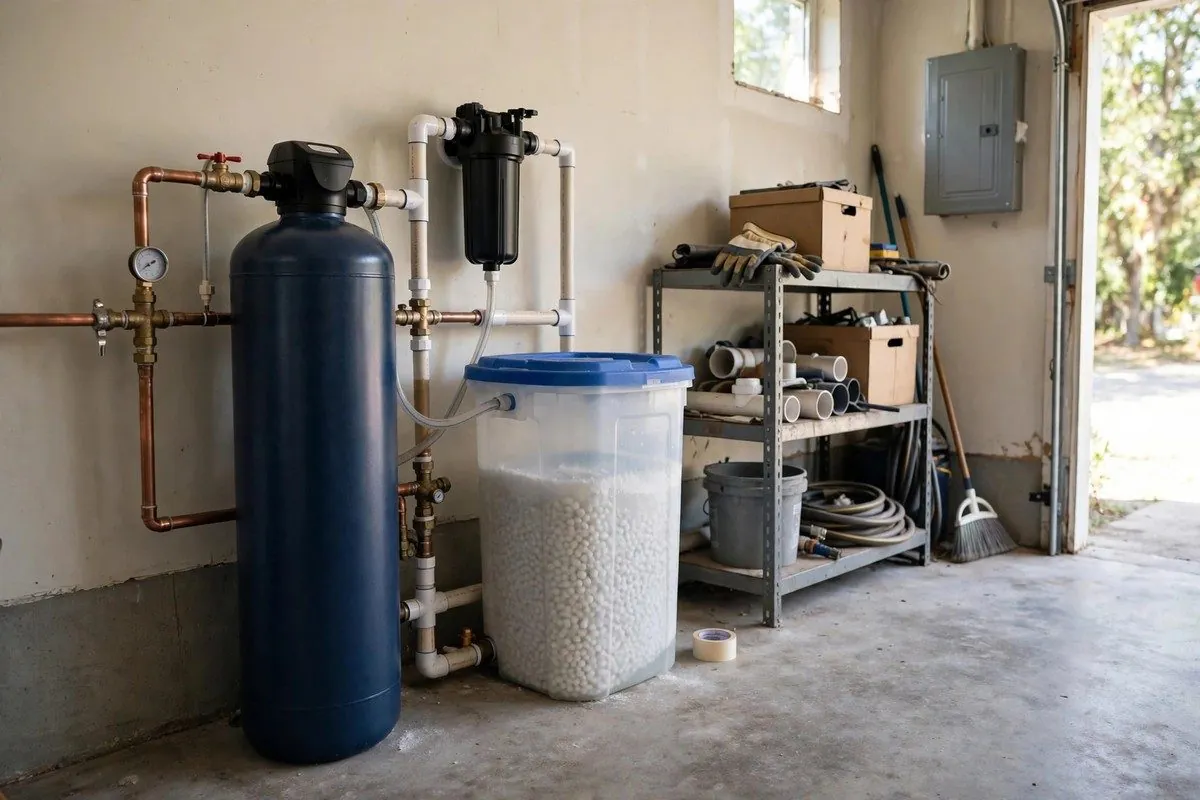
Water treatment works best when it is matched to a real problem. This page covers softeners for scale, filters for taste, sediment and chlorine, and the plumbing that connects them. If a treatment unit has failed and is leaking, shut off the bypass valve and call, or see leak detection. For planned work, call to schedule.
Start with the test, not the product. Hardness, iron and chlorine call for different equipment, and a mismatch wastes money.
Do you need a softener
The City of Miamisburg softens its water. A 2022 water report puts the average hardness near 7.5 grains per gallon, or 128 milligrams per liter, down from about 22 before the softening plant started in October 2018. That is moderate, and many homes on city water do fine without a softener. If you notice scale on fixtures, spotted dishes or a short heater life, a small softener may help. Ask the city for the latest report at cityofmiamisburg.com/water-reports.
Homes outside the city system may be on a private well or another utility, and their water can be much harder. Test your own water before you buy anything. Your utility or a state-certified lab can do it.
Filters and what they remove
A sediment filter catches sand and rust. A carbon filter reduces chlorine taste and odor. A whole-house filter treats every tap, and an under-sink unit treats drinking water only. Reverse osmosis gives the most thorough treatment at one tap and wastes some water. Each filter has a replacement schedule, and a filter left in too long can do harm.
We install the unit, a bypass valve, a drain connection for softeners and pressure gauges so you can see when a filter is clogged. A softener also needs a drain and a power outlet nearby. For new lines or relocation, plumbing installation covers the supply side.
Reading your city water report
Public water systems publish a yearly consumer confidence report. The City of Miamisburg posts its reports on its website at cityofmiamisburg.com/water-reports, and it lists hardness, disinfectant and detected substances. Look for hardness in milligrams per liter, and divide by 17.1 to get grains per gallon. A reading near 128 milligrams per liter equals about 7.5 grains.
If you live in West Carrollton, Moraine, Springboro or Centerville, your water comes from a different system, and your bill names it. Ask that utility for its report. Do not assume one town's numbers apply to another, and we do not guess at them.
If you want a private test of your own tap, a state-certified lab can run it for a modest fee. We are happy to review the results with you before you buy equipment.
Which treatment for which problem
Match the equipment to the symptom.
| Symptom | Likely cause | Treatment |
|---|---|---|
| White scale on fixtures | Hardness | Water softener. |
| Chlorine taste or smell | Municipal disinfectant | Carbon filter. |
| Sand or rust particles | Sediment | Sediment filter. |
| Orange stains | Iron | Iron filter or softener rated for iron. |
| Drinking water quality concern | Varies | Reverse osmosis at the tap. |
Ask before you buy
Sales pitches skip these questions.
- What does a test of my water say.Buy for the measured problem.
- How much salt and water does it use.Operating cost matters.
- Who services it.Ask who handles repairs and parts.
- What warranty applies.Read what is covered and for how long.
Codes and standards behind this work
Treatment equipment is judged against consumer standards such as the NSF/ANSI standards for water treatment units. Installation follows the Ohio Plumbing Code, which the state adopts in Ohio Administrative Code Chapter 4101:3 for the bypass, the drain connection and backflow protection. Ask any seller which NSF/ANSI listing a unit carries and for which claim.
What affects the cost of water treatment
You get a clear price before work starts.
- Equipment type and sizeCapacity should match your household.
- Installation locationA basement install is simpler than a tight closet.
- Drain and electrical accessA softener needs both.
- MaintenanceSalt, filters and service are ongoing costs.
- Water testA lab test adds a small cost and avoids guesswork.
Ask whether the unit is rated for your household flow so it does not cut pressure.
Want your real number? Call (326) 465-0294
Water Softener and Filtration questions in Miamisburg
Many homes on city water do not, since the city softens its water. If you see scale or have a well, test first.
A grain per gallon equals about 17.1 milligrams per liter of calcium carbonate.
It adds a small amount of sodium. Ask your doctor if you are on a restricted diet.
Yes. We can check valves, drains and settings, and tell you what needs replacing.
Your water utility publishes it. For City of Miamisburg water, the reports are posted at cityofmiamisburg.com/water-reports.