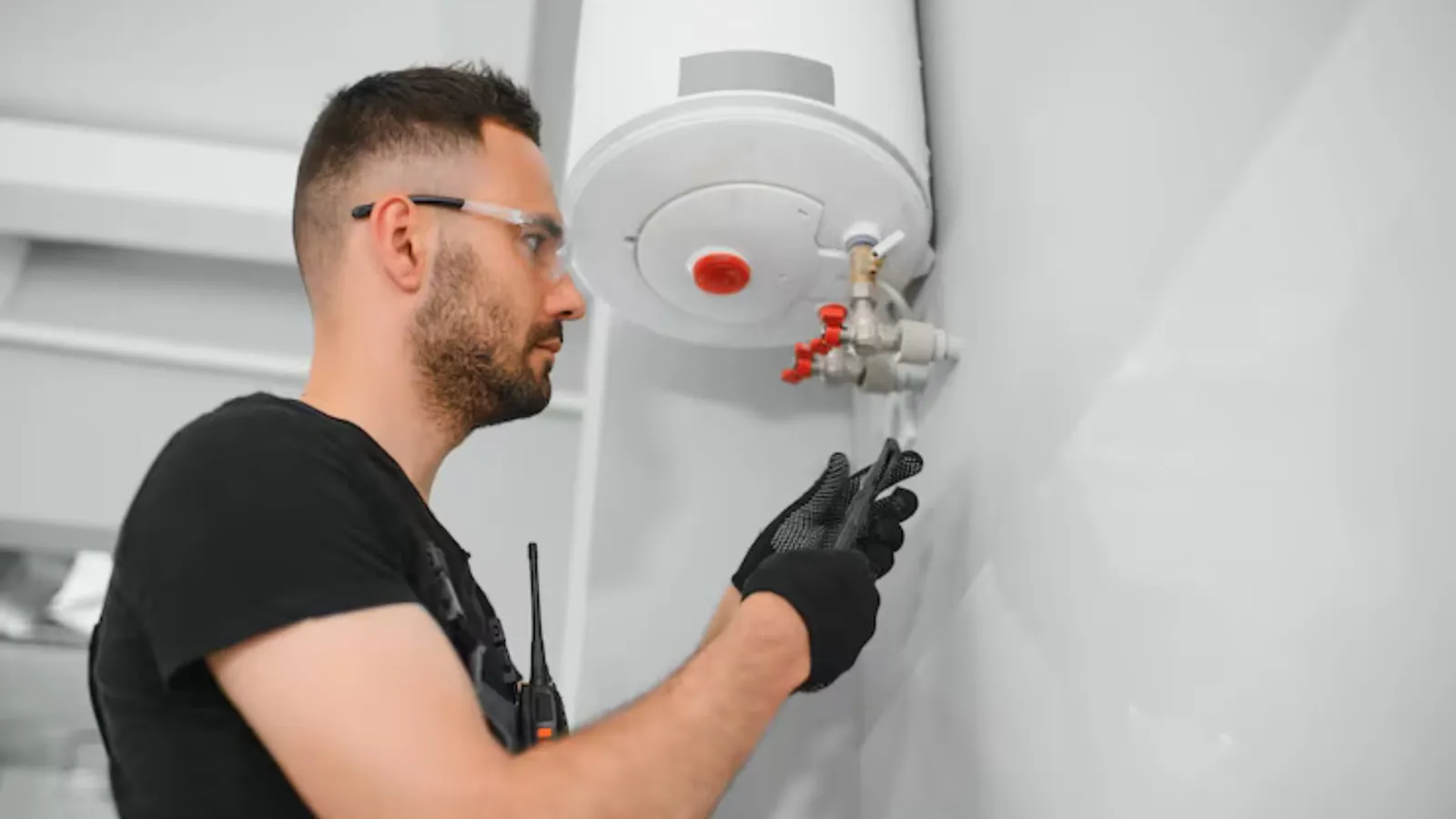
A water heater pressure relief valve, often called a T&P valve, opens when the tank gets too hot or the pressure climbs too high. It is the last safety device on the heater, and it exists to prevent a tank rupture. Replacing a worn one is a short job, usually under an hour for a plumber, and it is one of the cheapest safety upgrades in a house.
This guide explains how the valve works, the signs it is failing, how installation goes and the rules about its discharge pipe. If your heater is leaking from the valve right now, shut off the power or the gas, close the cold supply and call the 24/7 line.
How the valve works
The valve has a spring-loaded seat and a probe that sits in the top of the tank. If the water temperature passes about 210 degrees, or the pressure reaches about 150 pounds per square inch, the valve opens and releases water through a discharge pipe. When conditions return to normal, the spring closes it again.
Most residential valves carry a lever on the side. Lifting the lever for a second lets a burst of water out and confirms the valve moves. The valve should snap closed and stop dripping when you let go.
Signs the valve has failed
A relief valve rarely fails loudly. Watch for these.
- Constant dripping from the discharge pipe.A worn seat or high system pressure lets water seep out.
- Corrosion or mineral crust on the valve.Scale can lock the lever or the seat.
- A lever that will not move.A seized valve may not open when it must.
- Water pooling under the heater.The leak may be from the valve or the tank, and a plumber can tell which.
- The valve is more than five years old.Valves wear, and a fresh one is inexpensive protection.
Why a dripping valve is not always the valve's fault
Many dripping valves are doing their job. A closed plumbing system, with a check valve or a pressure reducing valve on the incoming line, lets pressure build as water heats and expands. Without an expansion tank, the pressure rises and the valve opens a little with each heating cycle. Replacing the valve alone will not fix that.
In that case, the right fix is a properly sized expansion tank on the cold supply. We test the system pressure with a gauge and check the expansion tank before we replace the valve.
Testing the valve safely
Put a bucket under the discharge pipe, or make sure the pipe ends over a floor drain. Lift the lever slowly, let a quart of water flow and let go. The valve should snap shut. A valve that keeps dripping needs replacing. A valve that gives no water at all may be blocked with scale, and that is a reason to call.
Do the test when the heater is warm but nobody is nearby. The water can be hot enough to burn. Keep children and pets out of the area, and never put a hand over the pipe.
Common causes of relief valve discharge
A quick guide to what we check.
| Cause | How we test | Fix |
|---|---|---|
| Excess system pressure | Gauge on a hose bib | Pressure reducing valve or expansion tank. |
| Missing or failed expansion tank | Tap and air valve test | Install or replace the tank. |
| Thermostat set too high | Check thermostat and water temperature | Lower the setting, repair the thermostat. |
| Worn valve seat | Valve drips with normal pressure and temperature | Replace the valve. |
Installation and the discharge pipe
The plumber shuts off power or gas and the cold supply, then drains the tank below the valve. The old valve comes out, thread sealant goes on the new one and the valve goes in with the probe in the tank. A discharge pipe is attached, running downward to a safe spot, typically within a few inches of the floor or to a drain.
The discharge pipe must never be capped, plugged or reduced in size. It must not rise, and it must not have a valve of its own. A capped valve is no safety device at all, and it can turn the tank into a bomb. If you see a cap, call a plumber.
What affects the cost of a relief valve installation
The valve is a small part. The cost depends on the rest of the visit.
- Valve ratingIt must match the tank pressure and the heater's input.
- Discharge pipe conditionOld, undersized or corroded pipe is replaced.
- Expansion tankIf the system needs one, it adds parts and labor.
- AccessA heater in a tight closet or attic takes longer.
- Hour of the callAn evening call carries a higher rate.
Ask whether the visit includes a pressure test, since pressure is the cause behind many valve problems.
Want your real number? Call (326) 465-0294
When the valve is a warning and not the problem
A valve that opens during a long, hot shower is telling you something. The water heater may be set too hot, the thermostat may have failed or the tank may be far past its age. If your heater is more than twelve years old, a leak at the valve is also a good time to ask whether the tank is nearing the end. Replacing a valve on a tank that is already failing wastes money.
What not to do
Do not plug a dripping valve to stop the leak. Do not raise the thermostat above 120 degrees to get more hot water without a mixing valve, since higher temperatures raise scald risk and stress the valve. Do not ignore a valve that has stopped dripping because it is now stuck shut. A stuck valve can look healthy until the day it is needed.
Codes and standards that apply
Temperature and pressure relief valves are listed to ANSI Z21.22. The Ohio Plumbing Code in Ohio Administrative Code Chapter 4101:3 requires a discharge pipe that runs to a safe location, without a cap or a shutoff valve.
Choosing the right valve
The valve must be rated for the heater. Its pressure rating, usually 150 pounds per square inch, should match the tank. Its BTU rating must be equal to or higher than the heater's input. The probe length matters, since the temperature element has to reach into the water. Ask the plumber to show you the markings on the new valve and the heater's data plate so you can see they match.
A good valve comes with a listing from a recognized testing lab. A low-cost valve with no markings is a bad bargain on a device that guards against a rupture.
Who to ask about permits in Miamisburg
The City of Miamisburg Building Department regulates fuel gas piping and HVAC. For a gas water heater, call (937) 847-6533 with approval questions, or (937) 847-6532 for inspections. Plumbing permits in Montgomery County route through Public Health, Dayton and Montgomery County at (937) 225-4421.
Replacing only the relief valve is a small repair and often does not trigger a permit. Replacing the heater usually does. A short call confirms what applies to your address.
Source: City of Miamisburg Building Department and the Montgomery County building directory, listed at cityofmiamisburg.com
Questions about water heater relief valves
Once a year is common. Lift the lever briefly and let it snap back. If it drips afterward, call a plumber.
Many last five to ten years. Scale and heat shorten that.
The water can be scalding. Keep people away from the discharge and shut off power or gas.
Every tank heater needs one. It must be rated for that tank, and the discharge must run to a safe spot.
Heating cycles raise pressure, and a closed system with no expansion tank pushes water out. A pressure test and an expansion tank usually solve it.
Often not for the valve alone, but rules vary by project. Call the Miamisburg Building Department at (937) 847-6533 to confirm for your address.
Relief valve dripping or heater leaking? Call the 24/7 line. We also work in Springboro and Moraine.
Call (326) 465-0294