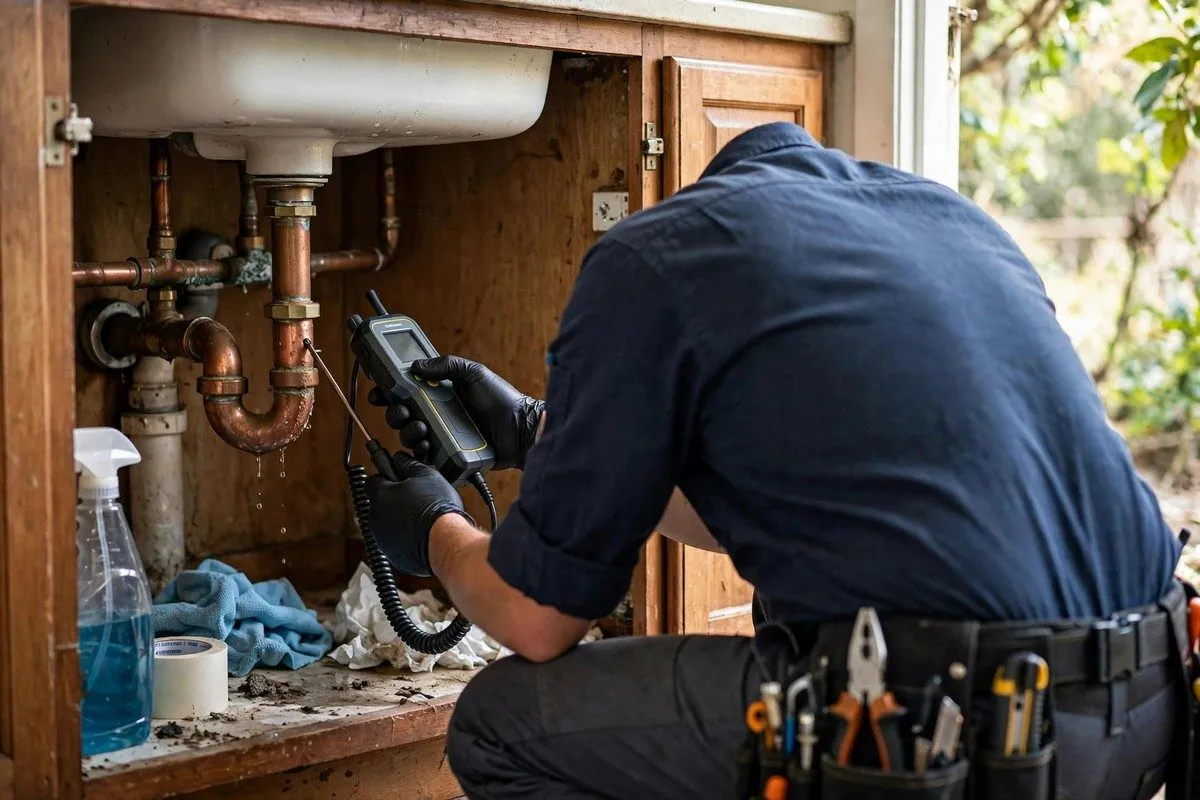
A UV leak detection light finds leaks by making a special dye glow. The dye goes into the system, escapes with the leaking water or fluid and shows up bright yellow green under an ultraviolet lamp in a dark room. It is a handy tool for finding small drips at fittings, drain traps, toilets and appliances, and it is cheap for a homeowner to try.
It is not a tool for every leak. A leak behind a wall or under a slab needs different methods. This guide explains where UV works, how to use it and what to do when it does not find anything. For hidden or persistent leaks, see leak detection.
How the method works
A fluorescent dye safe for plumbing is added to the water in a toilet tank, a drain trap or a section of pipe. The dye travels with the water. At a leak, it collects on surfaces around the opening. Under a UV lamp in a dark room, those surfaces glow brightly, even when the water has dried.
Wear UV safe glasses, which also make the glow easier to see. Clean the area first, since some cleaning products glow under UV and can fool you.
Where UV dye works well
These are the typical successes.
- Toilet tank to bowl leaks.Dye in the tank shows up in the bowl without a flush.
- Drain trap and slip joint drips.A small weep around a nut shows up as a glowing ring.
- Supply connections at faucets and appliances.Dye in the line marks the exact joint.
- Washing machine and dishwasher hoses.A worn hose leaves a glowing trail.
- Refrigerant and oil leaks in equipment.A different dye is made for those systems, and a technician uses it.
Choosing a UV kit
A basic kit has a UV flashlight, a bottle of dye and a pair of yellow glasses. Look for a lamp rated around 395 to 405 nanometers, which makes the dye glow strongly. Dye comes in forms for water, for oil and for refrigerant, and each is made for its own system. Buy the one that matches what you are testing.
Small, cheap lights sometimes put out too little UV to be useful. If the glow looks faint, try a brighter lamp or a darker room before you decide there is no leak.
UV light compared with other methods
No single tool finds every leak.
| Method | Good for | Limit |
|---|---|---|
| UV dye and lamp | Drips at visible fittings and fixtures | Cannot see inside walls or slabs. |
| Water meter test | Confirming a supply leak exists | Does not say where it is. |
| Acoustic listening | Pressurized lines in walls and slabs | Needs skill, background noise matters. |
| Thermal imaging | Hot water lines and wet materials | Needs a temperature difference. |
| Pressure test | Isolating one section of pipe | Needs access to shut off a section. |
A step-by-step home test
First, check whether you have a leak at all. Turn off every fixture, then look at the water meter. If the small dial or the leak indicator moves, water is flowing somewhere. Next, put dye in the toilet tank and wait fifteen minutes without flushing. Color in the bowl means the flapper leaks. Then dim the lights and sweep the UV lamp around trap connections, supply lines and under sinks.
If you find a glow, tighten the connection or replace the part. If the dye shows nothing but the meter still moves, the leak is out of sight, and it is time to call.
Common mistakes with UV kits
People often use too much dye, which can stain surfaces and make everything glow, so use the dose on the label. They test in a lit room, where the glow vanishes, so turn off the lights. They forget to wipe old residue first, so earlier spills light up and confuse the test. And they stop at the first glow, when a second leak sometimes sits behind it. Check the whole run of a line before you declare the job done.
What affects the cost of professional leak detection
A plumber may use UV along with other methods. The price depends on what the house requires.
- Method neededDye is inexpensive, acoustic and thermal methods use equipment.
- AccessFinished walls and slabs raise the difficulty.
- Size of the homeMore pipe means more time.
- Repair after detectionFinding the leak is one price, fixing it is another.
- Hour of the callEvening visits carry a higher rate.
Ask whether a repair quote comes with the detection, so you know the full cost.
Want your real number? Call (326) 465-0294
What to do when the dye shows a leak
Mark the spot with tape and note which fitting it is. Shut the supply valve to that fixture. Look at the part: a loose nut can be snugged a quarter turn, a cracked washer or a worn hose needs replacing, and a corroded fitting means the pipe may be failing nearby. Dry the area, run the water for a few minutes and check again.
If the leak is at a soldered joint or a threaded steel fitting, call a plumber. Over-tightening can crack a fitting and turn a drip into a flood.
Safety notes
Use dye made for plumbing and follow the label. Do not look into the UV lamp or aim it at anyone's eyes. Wear the glasses that come with the kit. Do not pour dye into a drinking water supply unless the label allows it. If water is actively spraying or flooding, shut the main valve first and use the dye later.
Codes and standards that apply
Choose a dye that meets the maker's guidelines for potable water and follow the label. Pressure testing a line follows the pipe maker's limits and the Ohio Plumbing Code in Ohio Administrative Code Chapter 4101:3.
Dye is evidence you can keep
Photograph the glow with the lamp on. A clear picture of a leaking fitting helps if you need to show a landlord, an insurer or a contractor what you found. It also tells you whether the repair worked, since a second test after the fix should show a clean, dark surface.
Reading your water meter in Miamisburg
The City of Miamisburg Public Works can answer questions about your water meter and billing at (937) 847-6635, or by email at PublicUtilities@cityofmiamisburg.com. If your bill jumps with no change in use, a quick meter check is the best first step.
The city's drinking water comes from five production wells beside the Great Miami River. A sudden bill increase on that system is most often a leak on the private side, such as a toilet, a hose bib or a buried line.
Source: City of Miamisburg Public Works and water reports at cityofmiamisburg.com/water-reports
Questions about UV leak detection
Dye made for plumbing is safe when used as directed. Follow the label.
Not by itself. A hidden leak needs acoustic, thermal or pressure methods.
Plumbing dye is made not to stain, and a few flushes clear it.
It can glow for days or weeks, depending on the product.
Dye in a drain can help trace a path, but a camera usually gives a better answer for sewer problems.
Start with Miamisburg Public Works at (937) 847-6635. A plumber can then check the private side of the line for leaks.
Dye did not find it? Call the 24/7 line and a plumber can trace the leak. We serve Miami Township and Moraine. For active flooding, see burst pipe repair.
Call (326) 465-0294