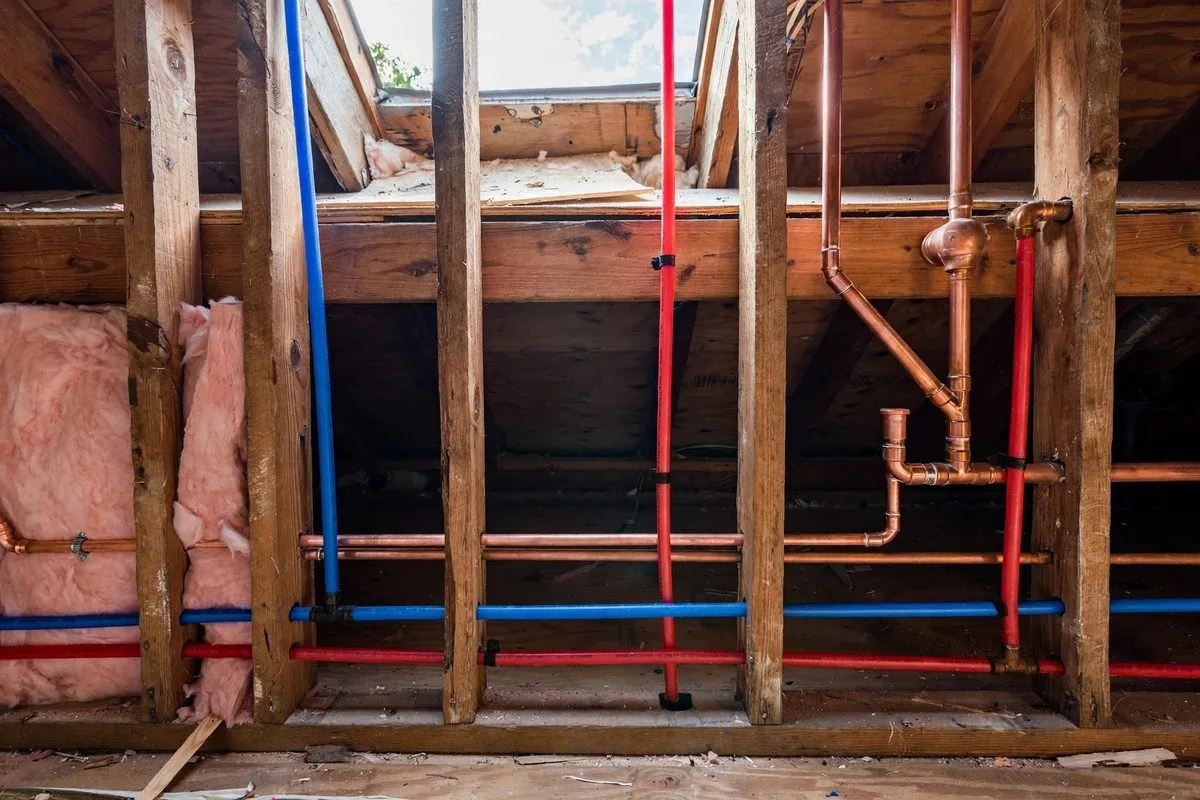
Copper has been the standard pipe for residential supply lines for decades, and it is still a solid choice. It resists corrosion, handles heat and lasts fifty years or more when installed well. It also costs more than PEX, takes longer to install and can develop pinhole leaks in certain water conditions. Knowing the types and the failure modes helps you decide whether to keep it, repair it or replace it.
This guide covers copper types, typical problems, how it compares with PEX and what to ask a plumber. For whole-house work, see repiping.
Types K, L and M
Copper pipe for water comes in three common wall thicknesses. Type K has the thickest wall and is used for buried service lines. Type L is the usual choice for interior supply lines. Type M has the thinnest wall and is common in older tract homes, where its lower cost mattered. Wall thickness affects pressure rating, durability and how well the pipe resists pitting.
To find out what you have, look for the printed stripe on the pipe: green for K, blue for L, red for M. Many older pipes have been painted or are hidden, so a plumber can test or sample a section.
Copper types at a glance
Match the type to the job.
| Type | Wall | Typical use |
|---|---|---|
| K | Thickest | Underground service lines. |
| L | Medium | Interior supply lines. |
| M | Thinnest | Light-duty interior lines in older homes. |
How copper is joined
Most copper in homes is soldered, with a flux that cleans the metal and a lead-free solder that flows into the joint when heated. Press fittings, which are crimped with a special tool, are a newer method that avoids open flame. Compression and flare fittings join pipe at valves and fixtures. A joint done well lasts as long as the pipe. A joint done badly, with too little solder or a dirty pipe, weeps for years.
Ask whether the plumber solders or presses, and whether the job needs a flame permit or a fire watch. Soldering inside an old house with dry wood framing needs care, and good plumbers use shields and water on hand.
Why copper fails
Copper lasts a long time, and these are the common failure modes.
- Pinhole leaks.Tiny pits form inside the pipe and leak slowly, often from aggressive water or poor flux.
- Corrosion at fittings.Dissimilar metals and old solder can corrode at joints.
- Freeze splits.A frozen pipe expands and splits a seam.
- Erosion.High flow and hot water wear the inside of elbows over decades.
- Bad workmanship.Overheated joints, no flux cleanup or poor supports shorten life.
Copper compared with PEX
PEX is a flexible plastic pipe that is faster and cheaper to install, with fewer joints. It does not corrode and handles minor freezing better. Copper is rigid, lasts a long time, resists UV and hot-water heat and has a long track record. Many plumbers use both: copper where it shows, PEX in walls.
Neither is perfect. PEX can be damaged by sunlight and by some chemicals, and it must be installed within the manufacturer's rules. Copper can be hit by pinhole corrosion. The best choice depends on your house, your budget and your water.
Pinhole leaks in detail
A pinhole leak starts as a pit on the inside of the pipe. Water chemistry plays a part, including pH, chlorine and dissolved minerals, and so do flow speed and the quality of the original soldering. The pit grows until it breaks through, leaving a hole the size of a pin that sprays a fine mist. It often shows up first as a damp spot or a stain on a ceiling.
A plumber can cut out the bad section and replace it with a coupling and a short length of pipe. If a second and a third pinhole appear within a year or two, the pipe is telling you it has a systemic problem. Repairing each leak costs more over time than a planned repipe.
Signs your copper needs attention
Look for green or blue crust at fittings, which means a slow leak. Look for stains on ceilings and walls near pipes. Listen for hissing when everything is off. Notice a rise in the water bill, a drop in pressure or blue-green stains in the sink. A plumber can pressure test lines and take a look at the interior with a small camera.
A single pinhole may be repairable. A pattern of pinholes, which show up one after another, usually means the pipe is failing along its length. That is the time to discuss leak detection and a repipe plan.
What affects the cost of copper plumbing work
Copper costs vary with the market, and the labor depends on the house.
- Copper priceThe metal market affects material cost.
- Pipe type and sizeThicker, larger pipe costs more.
- AccessFinished walls and slabs add labor.
- Number of jointsEach joint is soldered by hand.
- Permits and patchingAsk the building department what is required.
Ask for a written scope that names the pipe type and the number of fixtures.
Want your real number? Call (326) 465-0294
A word on lead and solder in older homes
Homes built before the late 1980s may have lead solder at copper joints, since lead solder was banned for potable water in 1986. If your home is older, a water test and a look at the joints are worth a visit. Ask your water utility about any lead service line inventory.
Codes and standards that apply
Copper tube types K, L and M are defined by ASTM B88, a published standard. Lead solder has been banned for drinking water systems since the 1986 federal Safe Drinking Water Act amendments, and installation follows the Ohio Plumbing Code.
Caring for the copper you have
Know where your main shutoff is and exercise it once a year so it will turn in an emergency. Check visible pipes for green crust, drips and loose supports. Keep exterior pipes and those in unheated spaces insulated, since a freeze can split a seam. Do not use the plumbing as a grounding path for electrical systems, and ask an electrician to check bonding if you do any remodeling.
If you hear water hammer, a bang when a valve closes, add water hammer arrestors. The shock wears joints over time.
How Miamisburg city water interacts with pipe
The City of Miamisburg treats its well water with oxidation, filtration, reverse osmosis softening, chlorine and fluoride, and its 2022 report lists an average hardness near 7.5 grains per gallon. Softened, treated water is generally gentler on pipe than very hard water, but older copper has years of earlier exposure.
If your home is outside the city system or on another utility, ask that utility for its latest report. Water chemistry decides how fast copper pits, and it differs from one system to the next.
Source: City of Miamisburg water reports at cityofmiamisburg.com/water-reports
Questions about copper plumbing
Fifty years or more is common. Water chemistry and workmanship change that.
Yes. It is a long-standing standard, and your utility monitors water at the tap.
Yes, with the right transition fittings.
Pipes expand as hot water runs through them. Supports and clips can reduce the sound.
Not always. Many copper systems last the life of the house. Repeated leaks or heavy corrosion are reasons to plan a replacement.
It remains a durable choice. City water is treated and softened, which is favorable, and a plumber can check your existing lines for pitting.
Copper leaking or turning green? Call and a plumber can look at it. We serve West Carrollton and Centerville, and a failing line may need burst pipe repair.
Call (326) 465-0294